

DeSantis announces expansion of recreational red snapper season
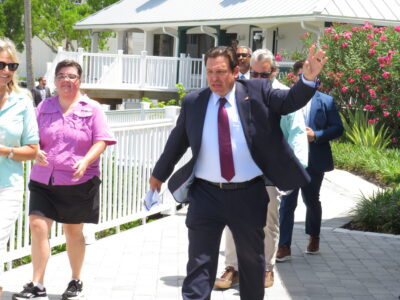
Gov. Ron DeSantis was at the Lighthouse Waterfront Restaurant in Fort Myers today to announce an expansion of the recreational red snapper season on the Gulf from 126 days last year to 140 days this year. He also announced an expansion of the Atlantic red snapper recreational fishing season from two days to 39 days.
The recreational red snapper season on the Gulf will now run from May 22-July 31, and then from Sept. 1-Oct. 4, Oct. 9-11, Oct. 16-18, Oct. 23-25, Oct. 30-Nov. 1, Nov. 7-8. Nov. 14 – 15, Nov. 21 – 22, Nov. 26-29, December 5 – 6, 12 – 13, 19 – 20, Dec. 25-27 and Jan. 1-4. There is a limit of one fish per person.
The Atlantic red snapper season was significantly expanded from two days to 39 days from May 22 – June 20, and in October from Oct. 2 – 4, Oct. 9 – 11, a d Oct. 16 -18. Last year, recreational red snapper fishing on the Atlantic was limited to two days.
DeSantis said the large expansion of the Atlantic red snapper fishing season, was secured through the state requesting through the National Oceanic and Atmospheric Administration permission to manage recreational red snapper fisheries in both state and federal waters.
You must be a Florida registered fisherman to catch red snapper.
In an announcement of the new regulations by the Florida Fish and Wildlife Conservation Commission, the agency cited federal approval of Florida’s Exempted Fishing Permit, allowing the state to assume management of the recreational Atlantic red snapper fishery in both state and federal waters.
“We had state management of the Gulf red snapper but we did not have state management of the Atlantic red snapper,” DeSantis said Monday at the Lighthouse Waterfront Restaurant. DeSantis said he believed there was not enough days for red snapper season on the Atlantic coast.
“Bureaucrats would say ‘There is no more fish. You can’t let people fish more. They are not there,'” DeSantis said, adding he would speak to people who fish who said there are enough fish out there. “I said ‘This is unacceptable. We know there is fish. We know we can have an expansion. This data that these bureaucrats are saying is not accurate data,'” DeSantis said. “Have the fish gone away? Their population is very healthy. There is a lot of fish in the sea.”
DeSantis said there is a “massive amount of red snapper” in the waters.
“This was a priority for us,” DeSantis said.
“Florida is the most angler-friendly state in the nation, and under my leadership, we are committed to expanding and protecting recreational fishing opportunities,” DeSantis said in a statement issued by the FWC. “With a record 39-day Atlantic red snapper season and a record-breaking 140-day Gulf red snapper season, Florida is empowering our anglers, protecting our waters, strengthening our coastal economy. And this is just the beginning.”
At Monday’s appearance at the Lighthouse Waterfront Restaurant, DeSantis said recreational fishing was “important to the economy,” citing an estimated $31 billion economic impact statewide related to boating.
“It’s been a great period for our boat manufacturers, they have been doing amazing here in Florida, it’s been good for the bait shops, ” DeSantis said.
James Evans, CEO of the Sanibel-Captiva Conservation Foundation, attended the press conference on Monday and said his organization had not yet had a chance to study the data the state used in determining there is a sufficient number of red snapper to support the expanded fishing season. Evans said SCCF will review the data, and wants to verify with the FWC that they made their determination “in good science.” Evans said the SCCF wants to ensure there are “sustainable fisheries”
Meanwhile, the SCCF continues to find that flows from Lake Okeechobee into the Caloosahatchee Estuary have been below the optimum flow envelope for 176 of the last 191 days.
“We are currently not meeting the minimum flow for the Caloosahatchee,” Evans said. “Right now, we are not getting enough freshwater flow to balance the salinity in the lower estuary. That means the saltwater is moving up the estuary to the W.P. Franklin Lock and Dam. Because there is a structure there, that means the low-salinity zone that is important for our bait fish that feed our economically-important fin fish and shellfish is getting smaller so the habitat volume is shrinking. We would really like to see more freshwater coming out of the Caloosahatchee whether it is coming out of the watershed or Lake Okeechobee to make sure that low-salinity zone is a large enough volume to balance the food source for our game fish in the estuary.”
Evans said the salinity in the estuary is also important for balancing the appropriate conditions for oysters, which can’t move on a reef.
“If we don’t get enough salinity, they can die,” Evans said. “Organisms which feed on them can come into those areas and kill those oysters. We see higher ratios of dead oysters to live oysters when we are not getting high enough freshwater inflows to balance that salinity. We also have impacts to tapegrass, which is a type of freshwater grass in the upper estuary. If we don’t have enough salinity, the salinity gets so high it will actually kill that freshwater tapegrass that is important to support our fisheries.”
Right now, Evans said the water quality is good in the bay and Gulf but not as good in the upper estuary (the Caloosahatchee River). “In the bay and in our coastal waters, the water clarity is spectacular right now, which is good for our seagrasses. As far as water quality goes for salinity in the upper estuary, I would say the conditions are poor and not meeting the salinity targets to balance the oysters, the tapegrass, the bait fish.”
The W.P. Franklin Lock and Dam separates the saltwater and freshwater flows. The estuary is considered to flow from the W.P. Franklin Lock and Dam down to Fort Myers.
Evans said the SCCF is calling on the U.S. Army Corps of Engineers and Southwest Florida Water Management District to “make sure they are sending appropriate freshwater flows.”