

Dolphin Tales: Male seahorses give birth
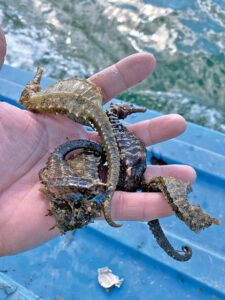
Seahorses and their close relatives, sea dragons, are the only species in which the male gets pregnant and gives birth. They are a species of fish.
The female seahorse has an ovipositor, which is a tube through which the eggs can be deposited outside the body. The female will deposit her eggs into the male’s brood pouch. This pouch is where the eggs can grow and receive all the nutrients and oxygen they need for a few weeks until birth.
After the seahorses are born, they are not nurtured by their parents. They are on their own from the beginning of life.
While there are approximately 50 species of seahorses worldwide, the Hippocampus Erectus is the most common form of seahorse found in our local waters. It is also known as the Lined Seahorse.
It can be quite difficult to see the Lined Seahorse because of the camouflage they use to hide themselves from predators.
Evan Hernandez, a full-time blue crabber on Pine Island, often finds the Lined Seahorses with their tail wrapped around his crab traps. They are beautiful!
They can be found hiding among the seagrass, mangroves, crab traps or cracks in seawalls where they can attach their tales and float in our shallow waters. This keeps them from being swept away by the current because they are poor swimmers. The fins on the side of their head can beat 50 times per second, helping them to steer.
Tiny crustaceans are their food source. Since they have no teeth, they have to use their straw-like snout to suction their food. They spend most of the day eating. Their eyes can move independently from one another so they can look out for food or predators.
Fortunately, the Lined Seahorse doesn’t have many predators. It is low on the food chain as its body is made up of a very thin layer of skin covering bony plates. It measures between 1 to 2 inches long.
The best way to find them is to wade in an area of seagrass with a net. Take a few swoops with the net. Then place the net in a bucket of water to transfer any seahorses from the net to the bucket.
If you do find a Dwarf Seahorse, try not to relocate them. They can only swim within a square foot of seagrass. These little guys mate for life. Ensuring that you’re keeping them in the same area helps the population stay alive.
Captain Cathy Eagle has spent over 40 years boating in our local waters. As a professional charter captain, she specializes in Dolphin and Nature tours. Visit CaptainCathy.com or call/text 239-994-2572. Welcome aboard!