

Expert shares insights about dolphins during March GPICA meeting
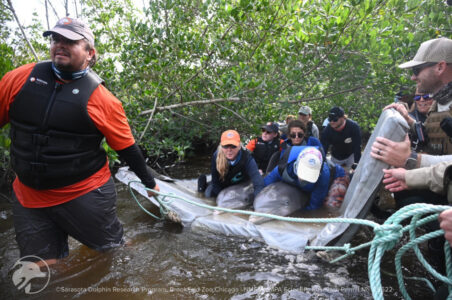
The March 3 meeting of the Greater Pine Island Civic Association featured one of the world’s leading dolphin researchers who shared information about the remarkable lives of bottlenose dolphins in Southwest Florida — including dolphins that live in Pine Island Sound.
Dr. Randall Wells, director of the Sarasota Dolphin Research Program and vice president of Marine Mammal Conservation at Brookfield Zoo Chicago, has studied dolphins in Sarasota Bay and surrounding waters for more than five decades. The program, which began in 1970, is the world’s longest-running study of wild dolphins.
Although his research focuses primarily on Sarasota Bay, Wells said the findings apply directly to the dolphins living around Pine Island.
“They’re the same species — just a couple of communities apart,” Wells told the audience, explaining that dolphins in different bays and sounds along Florida’s Gulf Coast behave in very similar ways.
Long-term residents of local waters
Early dolphin research assumed the animals ranged widely across the Gulf of Mexico. That idea changed as scientists began tracking individual dolphins and identifying them by the unique nicks and notches on their dorsal fins.
Those techniques revealed that coastal dolphins tend to stay within specific home ranges for decades. In Sarasota Bay, Wells and the SDRP have documented a long-term resident community of about 170 dolphins that occupy the same waters year-round and across multiple generations. Similar patterns have been documented in the waters around Pine Island.
From 1982 to 2007, scientists conducted photographic identification surveys in Gasparilla Sound, Pine Island Sound, Charlotte Harbor and Placida Bay. The results showed the same long-term residency as seen in the Sarasota Bay dolphin community.
Researchers have tracked individual dolphins in the Pine Island region for as long as 25 years and recorded some animals up to 34 times during that period. Even after major storms, the animals tended to remain in their home waters.
For instance, after Hurricane Charley, scientists were able to re-sight 94% of the dolphins that had been identified in the area before the storm, confirming that the animals remained residents of those same local habitats.
Complex social lives
Long-term monitoring has revealed that bottlenose dolphins live in complex social societies. Instead of fixed family “pods,” dolphins form constantly changing groups in what scientists call a “fission-fusion” society.
Males often form long-term pair bonds that can last for life, while females typically raise calves on their own.
Communication is also highly sophisticated. Each dolphin develops a unique “signature whistle,” which functions much like an individual name and allows dolphins to identify one another even in murky water where visibility is limited.
Studying dolphins from many angles
The Sarasota Dolphin Research Program uses a wide range of methods to understand dolphin populations.
These include photographic identification of dorsal fins, passive acoustic monitoring, the use of satellite-linked and radio tracking tags, genetic sampling through biopsies, health assessments conducted by teams of veterinarians and long-term behavioral observations.
Human activity is a major threat
While dolphins face natural predators such as bull sharks and tiger sharks, Wells said many of the biggest dangers come from human activity.
Data from dolphin strandings show that about 24% of documented dolphin deaths involve human interaction, including entanglement in fishing gear and boat strikes.
Fishing gear alone accounts for about 20% of those deaths, often when line wraps around a dolphin’s body and cuts into tissue as the animal swims. Boat strikes are another hazard, especially in shallow water where dolphins may not be able to avoid vessels passing overhead.
Feeding dolphins is also a major concern. Dolphins that learn to take fish from anglers or boaters are more likely to become entangled in fishing gear or struck by boats.
Wells offered practical advice for people who fish or boat in dolphin habitat. Among his recommendations:
• Never feed wild dolphins;
• Reel in fishing lines if dolphins appear nearby;
• Move to another location if dolphins continue to follow you;
• Be cautious when boating in shallow water where dolphins may surface beneath vessels.
“The best thing we can suggest is if dolphins come into the area where you are fishing, reel in for a while,” Wells said. “Just do what you can to minimize the fishing line being in the water.”
Dolphins as indicators of ecosystem health
Because dolphins live at the top of the coastal food web and share the same waters and fish as people, Wells said they serve as important indicators of environmental health.
“They are sentinels of ecosystem health,” he said, noting that what affects dolphins ultimately affects people as well.
For coastal communities such as Pine Island, that connection is especially close.
“We are neighbors,” Wells said. “We breathe the same air, swim in the same waters, catch and eat the same fish.”
For more information on how you can protect wild dolphins, visit www.SarasotaDolphin.org, where you can also sign up to receive emails about dolphin research and conservation.
Don’t miss the GPICA’s April meeting
The featured speaker during the GPICA’s April meeting will be from Lee County Code Enforcement. Have questions about Lee County zoning rules and regulations? Bring them with you to this meeting where you’ll have the opportunity to ask the experts.
When: 6:30 p.m. Tuesday, April 7
Where: First Baptist Church of Pine Island, 5363 Ave. D, Bokeelia (next to Pine Island Elementary School
To reach Special to The Eagle, please email pleblanc@breezenewspapers.com