

Oasis students visit robotics program at Lee Health
When it comes to surgical procedures in Lee County, Lee Health has you covered.
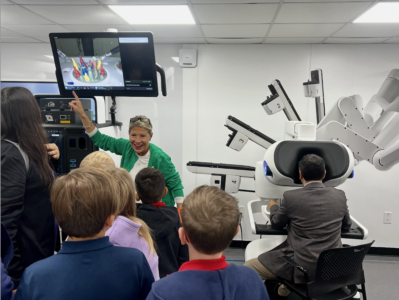
On Thursday, Oasis Charter students learned that by using the newest technologies, the robotics program at Cape Coral Hospital and Healthpark Hospital provides for more precise surgical effectivity and outcome. The robotics club members also got a lesson in the history of the program.
Dr. Juan Ibarra, Robotics Program manager at Lee Health since 2022, is excited about what’s currently being utilized and what’s on the horizon for the program.
“I really believe that Lee Health bringing all these new technologies, all these new robots, to be available for our surgeons and the community, it reflects that we are committed to accelerating innovation, drive, clinical excellence, and honestly elevate the experience of our patients, employees, and physicians,” he said.
When the program began in 2009, Healthpark Hospital received its first robotic model, the da Vinci, which is capable of many specialties and general surgery and can be used for everything from gynecological, colorectal, cardiothoracic, ears nose and throat surgery and beyond.
The program has expanded by leaps and bounds.
In 2020, Lee Health performed almost 1,000 procedures with the help of robotic tools. In 2025, almost 7,000 procedures were performed. Each year, the number continues to grow. There are now 33 robots used throughout Lee Health. Use of robotics in surgical settings offers the ultimate in precision, provides surgeons with a steady hand, and offers integrative AI in each model, a tool that continues to improve medical procedures across the country, health officials said.
Another robot model used daily in Lee Health systems is the ION model. The ION is used specifically to biopsy the lungs to detect lung cancer in the most minimally invasive way possible. According to the Lee Health website, 99% of patients will go home on the same day of their procedure. In addition, there is only 2% risk for complications associated with the ION system, a stark contrast to 20% risk for complications with a manual CT guided biopsy. In 2022, fewer than 2 cases could be diagnosed each day. Now four patients may be diagnosed due to the availability of the ION robotic system.
Another robot used by Lee Health is the Edison. This robot is capable of liquifying liver tumors, destroying cellular membranes to be reabsorbed into the lymphatic system, paving the way for better outcomes for those with the beginnings of liver cancer or cancerous tumors. There have been 35 surgeries with this particular robot at Lee Health since the end of September 2025.
There are currently five various models used in robotic surgery by Lee Health. The other two models are the ROSA system, which is used to aid in generating 3D x-rays for hip and knee replacement surgery, and the Excelcius GPS. The Excelcius GPS is a first of its kind – it’s used in spinal surgery for accurate alignment.
When asked if robots are the way of the future, and what his hopes were for the future of the program, Dr. Ibarra said “We are going to keep growing. I estimate this year we will perform 20% more robotic procedures than the year before. The technology we have will keep expanding.”
Robotics are only used as a tool in conjunction with human surgeons to offer better surgical outcomes, and recovery times, and to make the process less invasive – at least some of the time, health officials stressed.
Students from the robot club got a first-hand look at the da Vinci, ION, and Edison models, and got hands-on experience in what these robotic models are capable of.
Dr. Ibarra, Dr. Jordan Taillon, pulmonologist, and Kristine Hawkins, director of Surgical Services with Lee Health, were present to answer questions, showcase what the various robotic tools are capable of, and guide the students through their visit.
The hope is, in seeing these robots for themselves, and being educated on lung cancer throughout the visit, it will help the children make a decision not to smoke. Additionally, the experience allowed the children to see what they can build in the future when they grow up.